
Choosing an infrared heat lamp manufacturer requires more than comparing wattage and price. The right product must deliver controlled radiant heat, fit the intended holder, tolerate its operating environment, and remain consistent across repeat orders. A lamp sold for poultry brooding may need different glass, reflector size, packaging, and instructions from one used for bathrooms, reptile care, food warming, or industrial drying.
For importers and distributors, poor specification control creates avoidable risk. Incorrect voltage can shorten lamp life. Weak packaging can cause glass breakage. Vague application claims can lead customers to install the lamp at an unsafe distance. Certification gaps can also delay customs clearance or retail approval.
This guide explains how to compare infrared lamp types, technical data, quality controls, and commercial terms. It will help wholesale buyers prepare a clearer request for quotation, test samples properly, and select an infrared heat lamp manufacturer that can support a dependable OEM or private label program.

1. What Infrared Heat Lamps Do and Where Buyers Use Them
An infrared heat lamp converts electrical energy into radiant heat. Instead of heating all surrounding air first, it directs energy toward animals, people, food, or materials within its coverage area. This makes reflector-style lamps useful where focused, fast heat is required.
Common B2B applications include:
- poultry brooders and livestock warming areas
- reptile, pet, and veterinary enclosures
- bathroom ceiling heaters
- restaurant pass counters and food-warming stations
- paint curing, drying, and localized industrial heating
The application should be defined before the product. A 250W red R125 lamp may be familiar in agricultural distribution, but it does not fit every brooder layout. Mounting height, reflector diameter, ventilation, ambient temperature, and holder rating all affect performance.
Key point: wattage alone does not describe usable heat coverage or application suitability. A capable infrared heat lamp manufacturer should ask where the lamp will operate, which voltage and base the market uses, and what approvals the buyer expects.
2. Technical Specifications to Confirm With the Manufacturer
A useful quotation should identify the product precisely. Ask the infrared heat lamp manufacturer to confirm a specification sheet rather than relying on a catalog photo.
Important fields include:
- Rated voltage and frequency: typically matched to the destination market
- Rated power: common ranges may include 100W, 150W, 175W, 250W, and 275W
- Lamp shape and diameter: R95, R125, or PAR38, depending on the range
- Base: E26 or E27 are common, but the holder must match the voltage and load
- Glass color or finish: clear, red, or other application-specific construction
- Beam and heat distribution: relevant to mounting distance and coverage
- Overall dimensions: essential for fixtures, guards, and retail packaging
- Expected service life: confirm the test basis, not only the headline number
- Operating position: ask whether orientation restrictions apply
- Material and thermal design: especially the glass, reflector, base cement, and internal connections
Quality discussions should cover incoming materials, in-process checks, electrical safety, performance sampling, and final inspection. An OEM heat lamp factory may check power, insulation, base fit, appearance, heat consistency, and operating stability.
Sample approval should follow a defined sequence:
- Confirm the written specification and target application.
- Test sample dimensions and fixture compatibility.
- Measure actual power and observe heat distribution.
- Run the lamp in the intended position and environment.
- Approve labels, warnings, and packaging only after the product is accepted.
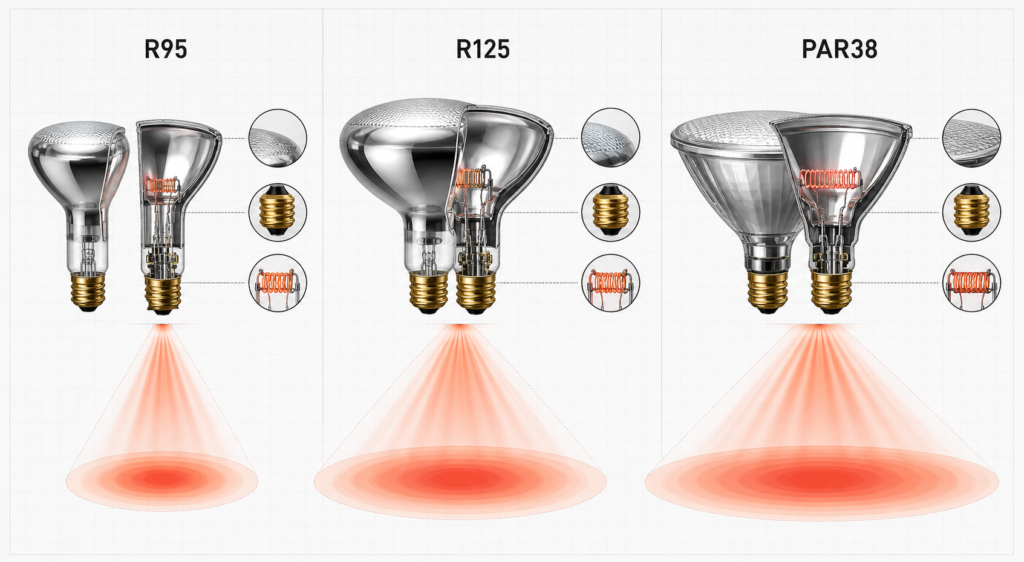
Two lamps marked 250W can behave differently because of reflector geometry and production variation. Ask how batches are checked against the approved sample.
3. Comparing R95, R125, and PAR38 Heat Lamps
Product names can vary by supplier and market. The table below is a sourcing reference, not a substitute for the final datasheet.
| Lamp Type | Typical Positioning | Common Buyer Priorities | Points to Verify |
|---|---|---|---|
| R95 infrared bulb | Compact localized heating | Price, fixture fit, retail replacement demand | Diameter, wattage range, glass strength, coverage |
| R125 heat lamp | Agriculture, animal care, bathroom heating | Higher heat output and familiar reflector format | Holder rating, mounting distance, ventilation, packaging |
| PAR38 heat lamp | Directional heat in robust reflector format | Controlled beam and application flexibility | Glass construction, beam pattern, dimensions, outdoor-use claims |
| Red infrared lamp | Animal care and visible-glare reduction positioning | Market familiarity and application labeling | Red finish consistency, heat performance, warning text |
| Clear infrared lamp | Food warming or general radiant heat positioning | Direct output and easy visual inspection | Application approval, glare, fixture protection, instructions |
Buyers should compare complete offers, not isolated unit prices. Put every agreed parameter into the purchase specification. Model, voltage, wattage, base, dimensions, color, packaging, certification marks, and inspection criteria should match across the quotation, approved sample, artwork, and purchase order.
4. Procurement Factors for Importers and Distributors
Commercial execution often determines whether a heat lamp program remains profitable. Discuss the following points with the infrared heat lamp manufacturer before approving an order.
MOQ and product mix
Ask for separate MOQs for standard lamps, branded lamps, and custom boxes. A factory may allow several wattages in one shipment, while each printed package still requires its own minimum quantity. Confirm whether R95, R125, or PAR38 models can share an export carton.
Certifications and compliance
Compliance depends on destination, product construction, and use. Buyers may request CE, RoHS, or other market-specific documentation, but a logo on a datasheet is not enough. Confirm the exact model covered, report holder, applicable standard, validity, and labeling rules. Your importer or compliance adviser should verify final requirements.
Packaging and breakage control
Glass lamps need packaging designed for export handling. Review inner support, box strength, carton partitions, carton quantity, gross weight, and pallet requirements. Request a packed sample, not only a digital design.
Lead time and order control
Separate sample time, artwork approval, production, inspection, and shipping. The infrared heat lamp manufacturer should state when the production clock begins and what normally limits repeat-order capacity.
OEM and private label options
Typical options include lamp marking, brand labels, color boxes, multilingual instructions, barcodes, master carton marks, and mixed product planning. Deeper changes to wattage, glass, or construction require technical review and may change MOQ, cost, testing, and lead time.
Shipping and inspection
Compare carton dimensions and container utilization, not just pieces per carton. Agree on pre-shipment inspection criteria for quantity, appearance, markings, packaging, and sampled electrical performance. Buyers may use their own inspector or request factory inspection records.
5. How MoreBulb Supports Infrared Heat Lamp Projects
MoreBulb works as a China lighting manufacturer for importers, distributors, brands, e-commerce sellers, equipment factories, and project contractors. Its infrared range sits alongside LED bulbs, filament bulbs, grow lights, appliance bulbs, and smart bulbs, simplifying mixed-category sourcing.
For an infrared project, MoreBulb can structure the discussion around:
- application and destination-market requirements
- suitable R95, R125, and PAR38 product options
- voltage, wattage, base, dimensions, and packaging details
- sample confirmation before mass production
- OEM branding, labels, instructions, and carton marks
- production inspection and export packing coordination
This factory-side process helps buyers turn a general request into a controlled specification. It also creates a clear reference for repeat orders. MoreBulb does not replace the importer’s compliance responsibility, but its team can provide available product information and discuss documentation needs early.
Buyers evaluating MoreBulb as an infrared heat lamp manufacturer should share the target country, sales channel, application, annual volume, required certifications, and preferred packaging at the RFQ stage.
FAQ
What information should I send to an infrared heat lamp manufacturer?
Send the destination country, application, voltage, wattage, lamp shape, base, order quantity, certification needs, and packaging plan. Include fixture dimensions or an existing sample if compatibility is critical. Tell the manufacturer whether the product is for agriculture, pet care, bathroom heating, food warming, or industrial use. This prevents a generic quotation that may not fit your market.
What is the difference between R95, R125, and PAR38 heat lamps?
The names mainly describe different reflector formats and approximate dimensions, but exact construction varies. R95 is more compact, while R125 offers a larger reflector commonly seen in higher-output heating applications. PAR38 provides directional coverage in a distinct reflector format. Compare the actual drawing, wattage, beam or heat pattern, base, and fixture compatibility before selecting a model.
Which certifications are required for importing infrared heat lamps?
Requirements depend on the destination market, voltage, construction, and claimed application. CE and RoHS are often discussed for European sales, while other regions may require different safety or conformity evidence. Ask the infrared heat lamp supplier for model-specific reports and verify them with your importer, test laboratory, or compliance adviser before printing certification marks on packaging.
What MOQ should buyers expect for OEM infrared heat lamps?
MOQ depends on the standard product, wattage mix, lamp marking, and packaging customization. A neutral-box wholesale order may have a lower threshold than a private label program. Printed color boxes often have their own production minimum. Ask for an itemized MOQ by lamp model and packaging SKU, especially when combining several wattages in one shipment.
How should buyers evaluate infrared heat lamp samples?
Check the sample against the signed specification, including voltage, actual power, dimensions, base fit, markings, and visible workmanship. Test it in a correctly rated holder and intended operating position. Observe heat coverage and stability over time. Also review the packed sample for protection and labeling. Use qualified personnel and appropriate safety controls during any thermal or electrical testing.
Conclusion
Selecting an infrared heat lamp manufacturer is a technical and commercial decision. Define the application first, then compare lamp format, voltage, wattage, thermal construction, fixture fit, test controls, compliance documents, and packaging. Record the approved details so mass production and repeat orders follow the same standard.
Importers and distributors should also look beyond unit cost. MOQ by SKU, breakage protection, artwork control, inspection, lead time, and container efficiency all affect the landed result. A clear RFQ and a disciplined sample process make it easier to identify a dependable manufacturing partner.
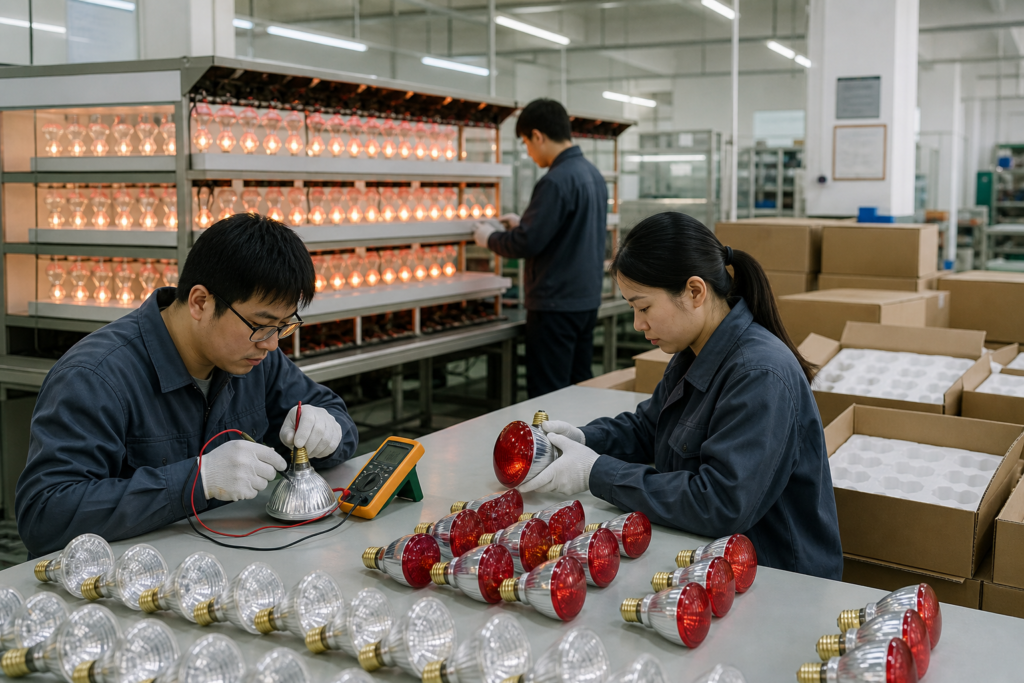
CTA
Contact MoreBulb for an OEM infrared heat lamp quotation, request R95, R125, or PAR38 samples, discuss private label packaging, or talk to the engineering team about your market and application requirements.