
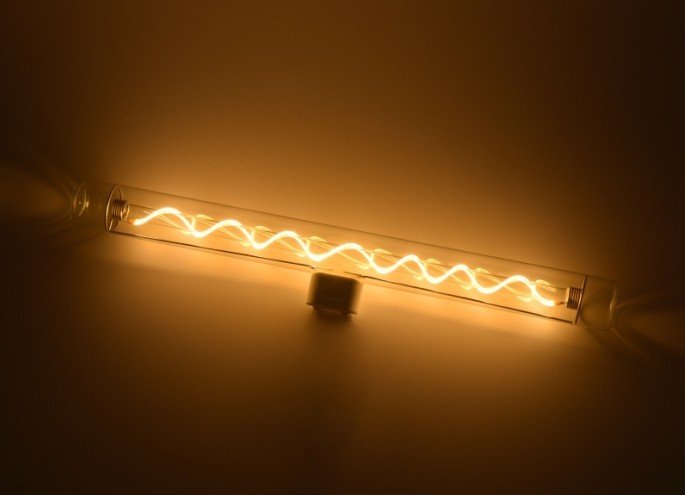
Choosing a Linestra lamp manufacturer requires more than matching length and wattage. A Linestra replacement must fit the holder, align with the fixture, deliver even light across the tube, and meet the electrical and labeling rules of the destination market. Base type, contact position, tube material, driver design, and color consistency all affect installation and customer returns.
Importers and distributors should compare S14s and S14d products as separate platforms. They should also distinguish classic linear mirror lamps from E14 or E27 decorative tubular lamps. Similar-looking samples may use different dimensions, diffuser materials, LED layouts, and flicker control.
This guide explains how to evaluate a Linestra lamp manufacturer for wholesale, OEM, and private label projects. It covers product formats, technical checks, specification comparisons, MOQ, certifications, packaging, lead time, OEM options, and shipping. Use it to prepare an RFQ, test samples, and select a Linestra lamp manufacturer that can control repeat production.

1. What Buyers Need to Know About Linestra Lamps
Linestra lamps are slim linear light sources used around mirrors, in wall fixtures, and in decorative lighting. LED versions replace older incandescent formats while reducing power consumption and surface heat. Their long shape creates a clean line of light.
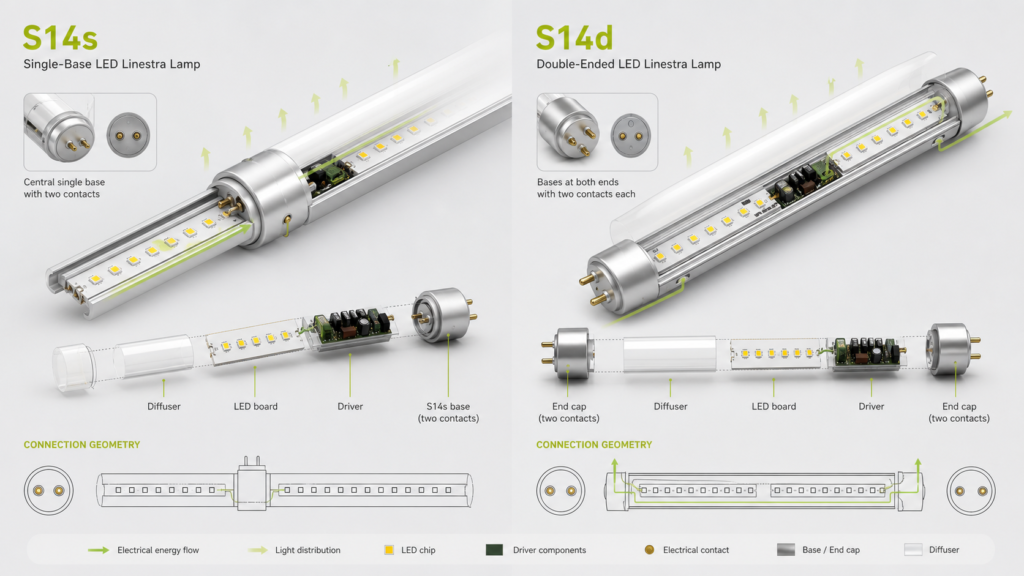
The first task for a Linestra lamp manufacturer is to identify the correct product family. S14s normally refers to a single-base format with two contacts on one central cap. S14d uses caps or contacts at both ends. The fixture, holder spacing, lamp length, and electrical design must match the selected format.
Decorative E14 or E27 tubular lamps can resemble a Linestra tube but are not direct S14s or S14d replacements. They need separate item numbers and compatibility claims.
For example, a buyer may need a frosted S14s lamp for mirrors and a clear E27 tube for hospitality fixtures. Their holders and optical effects differ.
Key point: approve the mechanical drawing before approving the appearance. A few millimeters at the base, contact, or overall length can make a good-looking lamp unusable in the target fixture.
2. Technical Design and Sample Validation
A reliable Linestra lamp manufacturer must coordinate the tube, caps, contacts, LEDs, driver, insulation, thermal path, and diffuser. Long products also need adequate rigidity.
Include these parameters in the specification:
- S14s, S14d, E14, or E27 base and a dimensioned mechanical drawing
- overall length, illuminated length, tube diameter, weight, and tolerances
- glass or PC construction, plus clear, frosted, striped, or opal finish
- rated voltage, frequency, wattage, power factor, inrush, and dimming status
- initial lumens, efficacy, CCT, CRI, color tolerance, beam pattern, and flicker data
- operating temperature, switching cycles, rated-life basis, warranty, and traceability
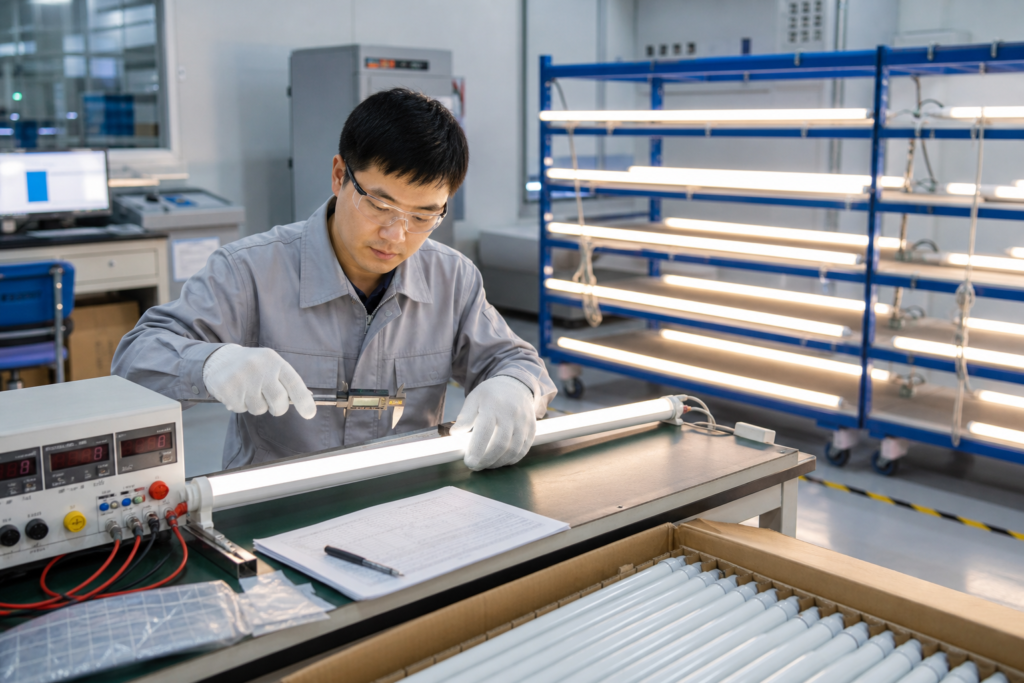
The LED layout should avoid visible dark zones, bright points, and color bands. Ask the Linestra lamp manufacturer to show the product switched on inside a representative mirror or wall fixture, not only on an integrating sphere.
Validate samples in a controlled sequence:
- Check all critical dimensions against the drawing and test the intended holders.
- Measure input power, power factor, lumen output, CCT, CRI, and flicker.
- Review light uniformity, glare, diffuser finish, base alignment, and audible noise.
- Run temperature and switching tests at the specified voltage and ambient condition.
- Complete aging, packaging, vibration, and drop checks before final approval.
Retain a signed golden sample. The LED bin, driver, diffuser, caps, markings, and carton should become controlled production references.
3. Comparing Linestra Lamp Specifications
Do not compare wattage and length alone. Use one normalized table for every Linestra lamp manufacturer.
| Specification | S14s LED Linestra | S14d LED Linestra | Decorative E14/E27 Tube | Buyer Check |
|---|---|---|---|---|
| Connection | Single central base | Contacts at both ends | Standard screw base | Match the exact holder and wiring |
| Typical use | Mirror and wall lighting | Longer linear fixtures | Decorative or custom fixtures | Test in the actual fixture |
| Tube options | Glass or PC | Glass or PC | Clear, frosted, opal, or striped | Approve material and finish |
| Length | Model-specific | Model-specific | Short to extended decorative formats | Define overall and illuminated length |
| Light appearance | Continuous diffused line | Continuous diffused line | Diffused or visible filament effect | Check dark zones and glare |
| Main risk | Base fit and alignment | End spacing and contact fit | Fixture clearance and weight | Approve a dimensioned drawing |
MoreBulb’s current Linestra product page presents tubular formats from approximately 55 mm to 1,500 mm, diameters from 16 mm to 38 mm, powers from 1 W to 24 W, and multiple voltage options. Treat these as portfolio-level ranges, not a promise that every combination is available. Request an exact SKU data sheet and sample from the Linestra lamp manufacturer.
Also compare thermal measurements, color shift, flicker method, and failures after aging. A low price may reflect fewer LEDs, wider binning, or thinner packaging.
4. Procurement Factors for Importers and Distributors
Commercial details determine whether an OEM Linestra program can scale reliably.
MOQ and samples
Ask for separate MOQs for standard lamps, printing, boxes, manuals, and custom designs. A stock platform may support a smaller pilot. A new length, cap, diffuser, driver, or molded part usually increases MOQ and development cost.
Certifications and market documents
Requirements vary by country, voltage, sales channel, and product construction. Electrical safety, EMC, energy efficiency, restricted substances, labeling, and producer-responsibility rules may apply. Do not accept a certificate for a similar round bulb. Ask the Linestra lamp manufacturer for reports that identify the exact family, driver, power, voltage, and construction. Confirm current obligations with an accredited laboratory or local compliance specialist.
Packaging
Long glass lamps need inserts that protect the tube and contacts. PC versions can still bend or scratch. Define individual protection, carton strength, drop tests, pallet pattern, barcodes, and handling marks. Test e-commerce parcels separately.
Lead time and OEM options
Separate drawing approval, samples, compliance testing, artwork, materials, production, aging, inspection, and shipping. OEM options can include logo marking, color temperature, wattage, tube finish, packaging, manuals, and carton labels. Ask which changes require new testing or tooling.
Shipping and inspection
Compare packed volume, loading quantity, spare ratio, and Incoterm. Pre-shipment inspection should cover quantity, dimensions, function, appearance, light data, labeling, and packaging. Record defect limits in the purchase agreement.
5. How MoreBulb Supports OEM Linestra Projects
MoreBulb works with importers, distributors, lighting wholesalers, brands, e-commerce sellers, fixture factories, and contractors. As a China factory-type Linestra lamp manufacturer with more than ten years of export experience, it can coordinate product selection, sample review, customization, production, packaging, and export preparation.
Project discussions can cover:
- S14s, S14d, E14, or E27 format and target fixture compatibility
- length, diameter, voltage, wattage, lumen output, CCT, CRI, and finish
- glass or PC construction and clear, frosted, opal, or striped appearance
- flicker, dimming, color consistency, thermal, aging, and switching checks
- private label printing, retail boxes, manuals, barcodes, and master cartons
- inspection criteria, golden samples, production traceability, and shipping plans
MoreBulb can review the market, application, forecast, price target, and packaging channel before recommending a standard platform or custom development path.
Buyers should confirm the final specification, compliance scope, artwork, lead time, warranty, and shipment terms in writing. A complete RFQ and golden sample give the Linestra lamp manufacturer a measurable production reference.
FAQ
What information should I send to a Linestra lamp manufacturer?
Send the destination market, voltage, frequency, base type, holder spacing, overall length, diameter, wattage, lumen target, CCT, CRI, tube material, finish, quantity, and packaging needs. Include fixture drawings or physical samples when fit is critical. State dimming, flicker, certification, inspection, warranty, and launch-date requirements. A complete RFQ allows the Linestra lamp manufacturer to quote a comparable product instead of guessing from a photo.
What is the difference between S14s and S14d lamps?
S14s is generally a single-base linear lamp with both electrical contacts in one central cap. S14d is a double-ended format that connects at both ends. They are not interchangeable. Exact holder geometry, contact position, overall length, and wiring must match the fixture. Ask for a dimensioned drawing and test samples in the intended holder before approving a bulk order or printing compatibility claims.
Is glass or PC better for an LED Linestra lamp?
Glass offers a familiar premium appearance, good dimensional stability, and several clear or diffused finishes. PC can reduce breakage risk and may suit demanding distribution channels, but material grade, heat resistance, UV stability, and scratch performance matter. The better option depends on the fixture, optical target, transport route, and price level. Compare illuminated samples and completed packaging tests rather than choosing by material name alone.
How can I check whether illumination is uniform?
View the lamp in the intended fixture at normal distance and from several angles. Look for dark ends, bright LED points, color bands, shadows from internal parts, and visible driver sections. Photograph samples with fixed camera settings, then compare units from the same batch. Photometric data confirms output and color, but visual fixture testing is still necessary because diffuser, LED spacing, and mounting geometry affect the light line.
What affects MOQ for private label Linestra lamps?
MOQ depends on whether the buyer selects an existing platform or requests a custom length, base, diffuser, driver, voltage, LED layout, marking, or package. Standard lamps with simple labels may support a smaller pilot. Printed boxes, multiple colors, new tooling, or market-specific testing can increase the minimum. Ask the Linestra lamp manufacturer to itemize MOQ, setup cost, sample time, and lead time for each customization layer.
Conclusion
Selecting a Linestra lamp manufacturer starts with mechanical compatibility. Confirm the base, contacts, holder spacing, length, diameter, material, and fixture clearance before comparing light output or price. Then validate uniformity, flicker, thermal performance, color consistency, aging, and packaging.
Put the approved drawing, specification, components, compliance evidence, MOQ, artwork, lead time, inspection method, and shipping terms in writing. This creates a clear reference for the first order and for repeat production.
Discuss Your Linestra Lamp Manufacturer Project With MoreBulb
Contact MoreBulb as your Linestra lamp manufacturer for an OEM quotation, request S14s or S14d samples, discuss private label packaging, or talk to the engineering team about fixture compatibility and custom specifications.
- OEM / ODM and private label support
- Product specification and sample review
- Packaging and export order coordination
- Factory-side quotation support