
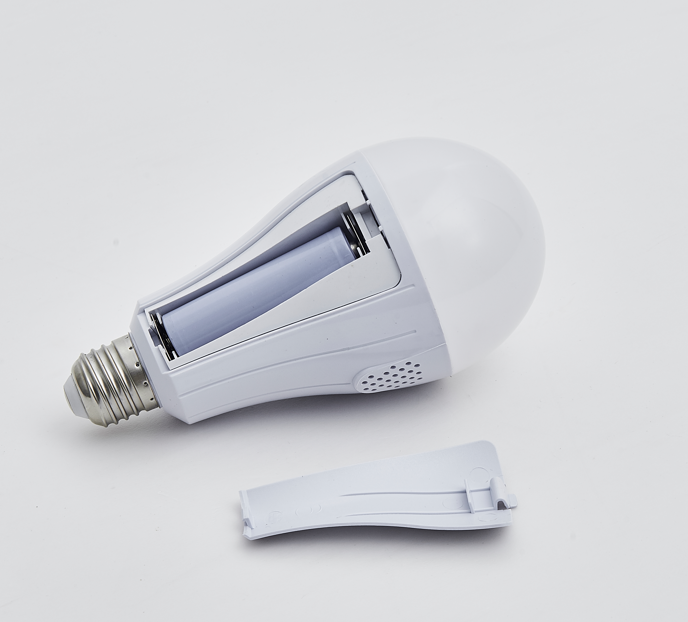
Choosing an emergency bulb manufacturer is not simply a matter of buying a standard LED bulb with a battery inside. The product must provide normal mains lighting, charge safely, detect a power failure, and deliver dependable backup light when the grid goes down. Battery quality, control logic, thermal design, and test consistency all affect returns and customer trust.
Importers, distributors, lighting wholesalers, and private label brands should therefore compare complete operating behavior, not only wattage and unit price. A claimed four-hour runtime means little unless the test method, emergency output, battery capacity, and cutoff point are defined. Fixture and switch compatibility also need confirmation before packaging claims are approved.
This guide explains how to evaluate an emergency bulb manufacturer, write a practical RFQ, and validate rechargeable LED emergency bulbs for wholesale or OEM programs. It covers product design, technical tests, specification comparisons, MOQ, certifications, packaging, lead time, OEM options, and battery-related shipping. Use it to select a product that performs predictably in both daily lighting and power-failure conditions.

1. How Rechargeable Emergency Bulbs Work
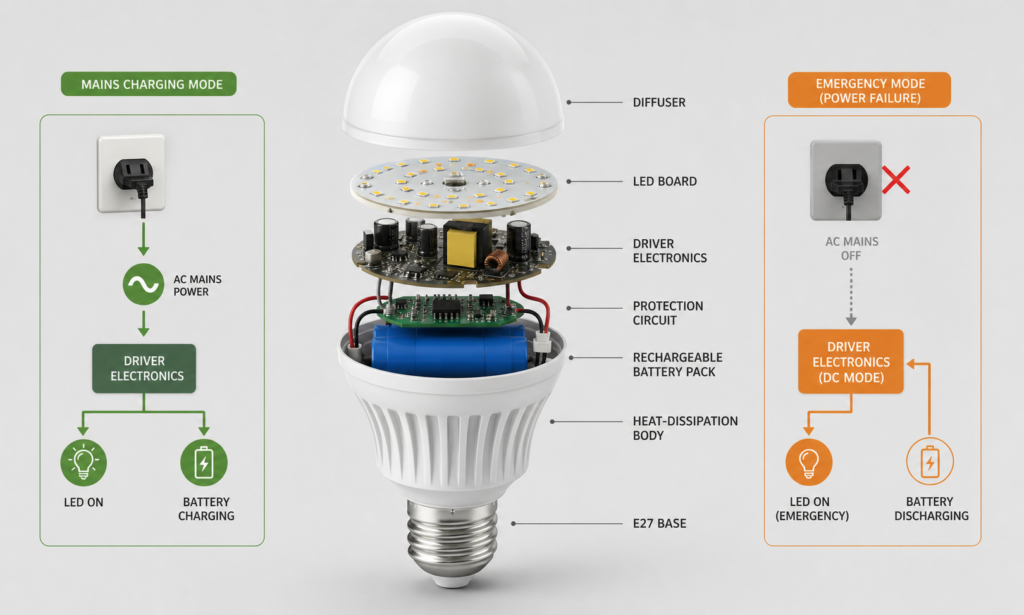
A rechargeable emergency bulb normally operates like an ordinary LED lamp while mains power is available. Its internal circuit also charges a battery. When the supply fails under the intended circuit condition, the control system changes to battery power and runs the LEDs at a reduced output.
The emergency bulb manufacturer should explain the exact behavior. Some models work in a conventional switched fixture. Others require the switch to remain on or include a hook, cap, or test holder. Never assume that every design detects an outage in the same way.
For example, two products may both be marked 12 W with three hours of backup. One may deliver 1,050 lumens on mains and 250 lumens in emergency mode. Another may provide only 150 lumens but run longer. The sales claim looks similar, but the user experience is different.
Key point: emergency runtime must always be read together with emergency light output. Ask the emergency bulb manufacturer to define mains output, backup output, minimum runtime, charging time, and test conditions on one approved specification.
Common uses include homes, shops, corridors, and markets with frequent outages. Do not describe a rechargeable bulb as a code-compliant emergency luminaire unless the complete product and installation meet local requirements.
2. Technical Design and Quality Validation
An emergency bulb manufacturer must coordinate the LED board, mains driver, charging circuit, battery, protection circuit, changeover logic, thermal body, diffuser, and base.
Ask an emergency bulb manufacturer to document these core parameters:
- rated voltage, frequency, mains wattage, power factor, and surge approach
- mains lumens, emergency lumens, CCT, CRI, beam angle, and flicker performance
- battery chemistry, rated voltage, capacity, supplier, and date code
- charging time, charge current, emergency runtime, and low-voltage cutoff
- overcharge, over-discharge, overcurrent, and short-circuit protection
- bulb dimensions, base, operating temperature, storage conditions, and warranty basis

The emergency bulb manufacturer should reproduce real use during sample validation. Buyers can approve samples in five steps:
- Measure electrical input, light output, CCT, CRI, and temperature in mains mode.
- Fully charge the product under the specified voltage and ambient conditions.
- Simulate a power failure using the intended fixture and switch configuration.
- Record emergency output over time until the protection circuit cuts off.
- Recharge and repeat the cycle to check recovery and sample-to-sample consistency.
Production controls should cover changeover, charging indication, battery voltage, electrical safety, lighting data, appearance, and aging. Periodic lot tests can verify runtime and cycles. The emergency bulb manufacturer should retain battery, driver, date, and inspection traceability.
Do not approve a golden sample after one outage test. Repeat cycles on several units and recheck them after storage.
3. Comparing Emergency Bulb Specifications
Compare each emergency bulb manufacturer on a normalized sheet. Headline values are not comparable when test conditions differ.
| Specification | Entry Retail Program | Higher-Performance Program | Buyer Check |
|---|---|---|---|
| Mains power | Often 7-9 W | Often 10-15 W | Confirm tolerance and input voltage |
| Mains output | Market-dependent | Higher lumen target | Verify integrating-sphere report |
| Emergency output | Lower for longer runtime | Balanced or higher backup output | Record initial and end-of-runtime lumens |
| Backup duration | Commonly claimed in hours | Defined minimum under stated load | Confirm cutoff and test temperature |
| Battery | Capacity selected for target cost | Higher capacity or controlled cell source | Verify chemistry, supplier, and traceability |
| Charging time | Depends on circuit and battery | Optimized for intended use | Test from protection cutoff to full charge |
| Product format | Standard E27 bulb | Larger body, hook, cap, or test accessory | Confirm fixture and switch behavior |
These ranges are sourcing examples, not MoreBulb model specifications. Request exact data for the offered SKU.
Compare battery capacity, backup brightness, cell source, protection, cycle testing, packaging, documents, and warranty. One emergency bulb manufacturer may quote a smaller battery or lower output while advertising the same runtime.
Ask whether the battery, LED, driver, and protection IC are controlled components. Substitutions can change temperature, runtime, light decay, and transport documents. Require written approval.
4. Procurement Factors for Importers and Distributors
Review every emergency bulb manufacturer on commercial terms as well as technical performance.
MOQ and samples
Request separate MOQs for the standard model, printing, box, manuals, and custom electronics. Existing designs may allow flexible pilots. New battery packs, molds, functions, or packaging increase MOQ and development time.
Certifications and documentation
Requirements depend on the destination, voltage, battery chemistry, product category, and sales channel. Buyers may need evidence covering electrical safety, EMC, energy performance, restricted substances, battery rules, labeling, and producer responsibilities. Ask for reports tied to the exact model and components. Confirm current obligations with an accredited laboratory or local compliance specialist.
Packaging and instructions
Packaging should separate mains and emergency output. Explain charging, switch behavior, setup, storage, and disposal. Avoid claims such as “works in every outage.” Test artwork, manuals, protection, and carton strength.
Lead time and OEM options
Separate sampling, testing, artwork, materials, production, aging, inspection, and shipping. OEM options include logo printing, boxes, manuals, CCT, wattage, battery capacity, diffuser design, and accessories. Confirm which changes require retesting.
Shipping batteries
Rechargeable lithium batteries are regulated for transport, including inside equipment. Packing depends on chemistry, configuration, quantity, route, and carrier. Request the applicable UN 38.3 test summary and safety data. Confirm acceptance with the forwarder; an electrical certificate is not battery transport approval.
5. How MoreBulb Supports OEM Emergency Bulb Projects
MoreBulb works with importers, distributors, lighting wholesalers, brands, e-commerce sellers, and project buyers. As a China factory-type emergency bulb manufacturer with more than ten years of export experience, it can coordinate product selection, sample review, private label preparation, production, and shipment planning.
Project discussions can cover:
- target voltage, wattage, mains lumens, emergency lumens, CCT, base, and size
- battery capacity, charging time, backup duration, and protection functions
- fixture, wall-switch, hook, cap, and portable-use requirements
- test samples for runtime, charging, temperature, aging, and packaging review
- logo marking, labels, manuals, retail boxes, master cartons, and pallet plans
- batch inspection, component control, traceability, and export documentation
MoreBulb can review the market, channel, price, forecast, and operating behavior before separating standard supply from custom development.
Buyers should provide a specification and retain an approved sample. MoreBulb can align quotation, sampling, packaging, and production checks with that reference. Certification scope, importer duties, battery registration, labeling, and transport acceptance still require market-specific confirmation.
FAQ
What should I include in an RFQ to an emergency bulb manufacturer?
State the destination country, voltage, frequency, bulb shape, base, mains wattage, mains lumen target, emergency lumen target, minimum runtime, charging time, battery preference, CCT, quantity, and packaging. Explain the intended fixture and switch behavior. Add certification, shipping, sample, inspection, warranty, and launch-date requirements. A complete RFQ lets the emergency bulb manufacturer quote the same performance level across every SKU.
How long should a rechargeable LED emergency bulb operate?
There is no single correct duration. The useful result depends on emergency brightness, battery capacity, product temperature, battery age, and the buyer’s application. Compare guaranteed minimum runtime at a defined output, not only a maximum marketing claim. Ask for a discharge curve or timed test record, then verify multiple samples after full charging and again after repeated cycles.
How can buyers verify the battery capacity claim?
Start with cell and pack specifications, supplier identification, date codes, and incoming inspection records. Then measure discharge capacity under a defined current and cutoff voltage. Test the complete bulb because driver efficiency and emergency LED load determine usable runtime. Capacity printed on a cell is not proof of delivered backup performance. Retain samples and compare production batches with the approved design.
Which certifications do emergency bulbs need?
The required evidence varies by market, voltage, battery type, and whether the product is sold as a general rechargeable bulb or regulated emergency-lighting equipment. Electrical safety, EMC, energy, chemical, battery, labeling, and recycling rules may apply. Transport documentation is a separate issue. Ask for exact-model reports and confirm current requirements with a qualified laboratory, importer, freight forwarder, or local authority before ordering.
What affects MOQ for private label emergency bulbs?
MOQ depends on the base product, battery pack, electronic changes, printed bulb, artwork, color box, manual, accessories, and number of market versions. A standard model with a label may support a smaller trial than a custom runtime, body, circuit, or battery specification. Ask the emergency bulb manufacturer to itemize MOQ, setup cost, sample time, and production time for each customization layer.
Conclusion
Selecting an emergency bulb manufacturer requires evidence for two operating modes. Confirm mains performance, emergency brightness, runtime, charging, protection, thermal behavior, switch compatibility, and battery consistency. Test several samples over repeated charge and discharge cycles.
Put component control, MOQ, certifications, packaging claims, lead time, inspection, and battery shipping documents in writing. A detailed specification and retained golden sample create a clear production reference for both buyer and factory.
Discuss Your Emergency Bulb Manufacturer Project With MoreBulb
Contact MoreBulb for an OEM emergency bulb quotation, request rechargeable LED bulb samples, discuss private label packaging, or talk to the engineering team about runtime, battery, and target-market requirements.
- OEM / ODM and private label support
- Product specification and sample review
- Packaging and export order coordination
- Factory-side quotation support